
Similarity in Tantric Entering of Sushumna and Yogic Pratyahara

1️⃣ Relate the Experience: “Energetic Throb triggered by Yogic efforts → inward → calm awareness”

energetic inward throb → then force vanishes into calm awareness

The “energy” phase is transitional
The “calm awareness” phase is the real direction

If one gets stuck in the first, it becomes energy-experience.
If it dissolves into the second, it becomes laya.


2️⃣Question: Is this yogic experience is same as Pratyāhāra in Yoga Sutras of Patanjali?

Short answer: partially correct, but incomplete


What Patañjali says about Pratyāhāra

Yoga Sutra 2.54–55:

  • senses withdraw from objects
  • mind becomes inward

This matches:

  • प्रत्यङ्मुखत्व (inward turning) from Yogataravali Verse 6

But does it include Kuṇḍalinī, Suṣumṇā, Nāda?

No — Patañjali:

  • does not describe kuṇḍalinī
  • does not describe nāḍī system explicitly
  • avoids energetic language

He describes functional states, not mechanisms.


So how to reconcile?

Yogataravali-style Patañjali-style
prāṇa centralizes senses withdraw
kuṇḍalinī awakens mind becomes inward
suṣumṇā entry attention stabilizes
nāda appears dhāraṇā possible

👉 Same process, different language.


Correct conclusion

Pratyāhāra corresponds to the beginning of inward turning,
but your verses describe deeper energetic mechanics beyond it.


3️⃣ Kuṇḍalinī “Sleeping in Mūlādhāra” — How to Understand?

This must be handled carefully — not literally.


Traditional Statement

  • Kuṇḍalinī lies “coiled” in mūlādhāra
  • It is “asleep”
  • Awakens through sādhana

Functional Interpretation

“Sleeping” means:

prāṇa is habitually outward and scattered

  • attention goes to objects
  • energy dissipates
  • no centralization

So “sleep” = unawakened inward potential


“Mūlādhāra” means:

Not just a location.

It indicates:

the base tendency of embodiment
(survival, grounding, outward identification)


“Awakening” means:

prāṇa becomes capable of inward, upward, central movement

Not a snake rising physically.


So the statement becomes:

“Kuṇḍalinī sleeps in mūlādhāra” =
“The inward potential of prāṇa remains unused while attention is outward-bound.”


4️⃣ Role of Yogic and Mantric Effort

yogic or mantric awakening

Let’s clarify both.


Yogic (bandha, prāṇāyāma)

  • act on prāṇa directly
  • reduce dispersion
  • force centralization

→ mechanical + energetic route


Mantric (japa, nāda, attention)

  • act on mind–attention
  • refine vibration
  • unify awareness

→ subtle + cognitive route


Both lead to same point:

reduction of outward fragmentation → inward unification

Which your verses call:

  • awakening
  • suṣumṇā entry
  • laya

5️⃣ Important Correction

Do not think:

“Kuṇḍalinī is an entity that rises”

Better to understand:

It is a process of reorganization of prāṇa–attention


6️⃣ Final Synthesis

Let me compress everything clearly:

  • Sleeping kuṇḍalinī = prāṇa scattered outward
  • Awakening = prāṇa begins inward movement
  • Bandha/prāṇāyāma = tools to enable that
  • Pratyāhāra = experiential beginning of inwardness
  • Suṣumṇā = non-oscillatory state
  • Nāda = subtle continuity in that state
  • Laya = dissolution of mind

🔍 Final Question (Very Precise)

In your experience:

When the “energetic throb” happens,

does it:

  • pull attention inward without effort,
    or
  • require you to stay focused to maintain it?

That difference shows whether:

  • kuṇḍalinī is self-moving, or
  • still dependent on intentional control.
Yogataravali Verse 3: Nadi Shodhana

सरेच-पूरैरनिलस्य कुम्भैः
सर्वासु नाडीसु विशोधितासु ।
अनाहताख्यो बहुभिः प्रकारारैन्तः
प्रवर्तेत सदा निनादः ॥३॥

(Minor sandhi variations like “सरेच” vs “रेचक” appear in manuscripts.)


1️⃣ Literal Meaning

  • सरेच–पूरैः कुम्भैः अनिलस्य
    — by exhalation, inhalation, and retention of breath
  • सर्वासु नाडीसु विशोधितासु
    — when all nāḍīs are purified
  • अनाहताख्यः … निनादः
    — the sound called “anāhata”
  • बहुभिः प्रकारैः अन्तः प्रवर्तेत
    — begins to manifest internally in many forms
  • सदा
    — continuously

2️⃣ Clean Meaning

“When, through rechaka, pūraka, and kumbhaka, all the nāḍīs are purified, then the inner sound known as anāhata begins to manifest continuously in many forms.”


3️⃣ What This Verse Actually States

This version is purely descriptive, not philosophical.

It says:

  1. Do prāṇāyāma
  2. Nāḍīs become purified
  3. Then:
    • anāhata nāda appears
    • internally
    • in many varieties
    • continuously

It does NOT yet talk about bodha.

This is important.


4️⃣ “बहुभिः प्रकारैः” — Many Forms of Sound

This matches classical descriptions found in texts like
Hatha Yoga Pradipika

Where nāda is described as:

  • bell
  • flute
  • drum
  • bee
  • thunder
  • etc.

So:

Nāda is not one fixed tone
It evolves as mind refines


5️⃣ “अन्तः प्रवर्तेत” — Arises Internally

The verse says:

  • अन्तः (within)
  • not specifically “heart”
  • not any chakra named

So strictly:

The text does NOT localize nāda to a specific chakra.


6️⃣ Important Insight

Nāda is presented here as:

  • a result of purification
  • not something artificially created
  • not imagined

It begins on its own when conditions are right.


7️⃣ No Metaphysics Yet

Notice:

  • no mention of Self
  • no mention of liberation
  • no mention of non-duality

This is still preparatory stage.

Just:

prāṇa → nāḍī → nāda


8️⃣ Where This Fits in the Flow

Now the verses form a clear progression:

  • Verse 2 → Nāda is best method
  • Verse 3 (earlier variant) → Nāda → bodha
  • This Verse 3 variant → how nāda arises

So this version is actually more foundational.


9️⃣ Very Important for Practice Understanding

This verse implies:

You do NOT “listen hard” to create nāda.

Instead:

  • balance prāṇa
  • purify system
  • nāda appears naturally

Then:
you work with it (as Verse 2 suggests)

There is another version of this verse. 

सरेच-पूरैरनिलस्य कुम्भैः
सर्वासु नाडीसु विशोधितासु ।
अनाहतादम्बुरुहादुदेति
स्वात्मावगम्यः स्वयमेव बोधः ॥३॥

(Minor sandhi variations like “सरेच” vs “रेचक” appear in manuscripts.)


Literal Meaning

  • सरेच-पूरैः कुम्भैः अनिलस्य — through exhalation, inhalation, and retention of breath
  • सर्वासु नाडीसु विशोधितासु — when all nāḍīs are purified
  • अनाहतात् अम्बुरुहात् उदेति — from the lotus (known as chakra - Amburuh means living in water ie lotus) and from the nada of anāhata,  arises
  • स्वात्म-अवगम्यः बोधः — the knowledge (realization) of one’s own Self
  • स्वयमेव — by itself, spontaneously

1️⃣ Structure of the Verse

This verse gives a complete inner mechanism:

Prāṇāyāma → Nāḍī purification → Center (chakra) → Anahata Sound→  Self-knowledge

This is not philosophy.
This is process.


2️⃣ “रेचक – पूरक – कुम्भक”

These are the three classical movements:

  • Rechaka — exhalation
  • Pūraka — inhalation
  • Kumbhaka — retention

But here they are not just breathing exercises.

They are used to:

Regulate prāṇa so that mind becomes still.


3️⃣ “नाडीशुद्धि” — Purification of Channels

Nāḍīs are subtle pathways of prāṇa.

When they are “impure”:

  • prāṇa flow is irregular
  • mind is restless
  • attention disperses

When purified:

  • prāṇa becomes balanced
  • attention stabilizes
  • inward movement becomes natural

This prepares ground for what you experienced as nāda.


4️⃣ “अनाहतात् अम्बुरुहात्” — Anahata Sound Emanating from Lotus

Very important term.

  • Anāhata = “unstruck” (same root as nāda)
  • Amburuha = lotus or chakras as defined in Kundalini Yoga

So this is:

The chakras or centers in subtle body  — not physical organ

This is where:

  • nāda becomes prominent
  • awareness becomes inward
  • duality begins to weaken

5️⃣ “स्वयमेव बोधः” — The Most Important Line

This is the heart of the verse.

Self-knowledge arises by itself

Not produced.
Not constructed.
Not achieved.

This is pure Advaita.

All practices only prepare.

When obstruction clears:

Knowledge shines spontaneously.


6️⃣ Connection with Verse 2 (Nāda)

Now the sequence becomes clear:

  • Verse 2 → Nāda is best method
  • Verse 3 → How that becomes possible

Prāṇa purified → nāḍīs clear → attention inward →
anāhata → nāda →
laya →
Self-knowledge


7️⃣ Deep Insight from this Verse

The practitioner who experience:

  • inner sound (nāda)
  • inward attention

For them, this verse explains:

That is not random.
It is consequence of subtle prāṇic alignment.

But the key point:

Do not try to “produce realization.”

It says:

स्वयमेव (by itself)

Your role:

  • stabilize
  • refine
  • not interfere

8️⃣ Essence in One Line

When prāṇa becomes balanced and inward, Self-knowledge arises spontaneously from centers known as chakras via Anahata nada.

Now Still Question Remains-

How listeing to Anahata Nada reach Self-knowledge?

Please refer this link

https://antaryogi.me/reaching-to-self-knowledge-by-listening-to-anahata-nada/

Or The Question Remains For-

How Nadi Shodhana happens due to Pranayama?

Please refer this link

https://antaryogi.me/how-pranayama-leads-to-nadi-shodhana/

Yogataravali Verse 2 : Layayoga

सदाशिवोक्तानि सपादलक्ष-
लयावधानानि वसन्ति लोके ।
नादीनि तान्यत्र कथं प्रवक्ष्ये
योगस्य सारं तु मया निगद्यते ॥२॥ 

(Minor wording variations exist across editions.)

Basic Meaning

  • “The teachings spoken by Sadāśiva — amounting to one and a quarter lakh (125,000) instructions on laya (absorption) — exist in this world. How can I recount all of them here? Therefore, I shall state only the essence of Yoga.”

Important Observations

  1. Reference to Sadāśiva
    This invokes the Śaiva yogic tradition — interesting in a text attributed to Adi Shankaracharya.
  2. Sapādalakṣa (1¼ lakh)
    Symbolic of vast yogic methods — especially laya-yoga techniques.
  3. Statement of Method
    Shankara (or the author) says:

    I will not give countless techniques.
    I will give the essence.

This sets the tone:
Not ritual multiplicity — but distilled inner method.


Now this is where it becomes interesting for someone like you:

The word लयावधानानि (attentions toward dissolution) indicates that:

  • Yoga here is not achievement.
  • It is systematic dissolution (laya).

Very close to Trika’s notion of absorption into source — yet Advaitic in culmination.

The word लय (laya) literally means:

Dissolution
Absorption
Melting back into source

So Laya Yoga is the yoga of dissolution.

But dissolution of what?


What Dissolves in Laya Yoga?

Not the body.
Not the world.
Not consciousness.

What dissolves is:

  • Mental modifications (vṛttis)
  • Ego-sense (ahaṅkāra)
  • Outward movement of attention
  • Separation between knower and known

It is the melting of mind into its causal stillness.


Classical Definition

In yogic literature, Laya Yoga means:

Absorption of the mind into its source through inner concentration, nāda, prāṇa control, or kuṇḍalinī ascent.

It appears in Haṭha and Tantric traditions, especially in:

  • Hatha Yoga Pradipika
  • Shiva Samhita

But here in Yogataravali, it is distilled into an Advaitic culmination.


Mechanism of Laya

The sequence is subtle:

1️⃣ Mind follows prāṇa

Where prāṇa flows, attention flows.

2️⃣ Prāṇa is steadied

Through breath regulation or subtle awareness.

3️⃣ Movement reduces

Thought frequency decreases.

4️⃣ Mind sinks

Like a wave settling back into ocean.

This “sinking” is laya.


Important Distinction

There are two types of laya:

⚠️ Temporary Laya

  • Deep sleep
  • Trance
  • Emotional overwhelm
  • Blankness

Mind stops temporarily but ignorance remains.

🌿 True Yogic Laya

  • Awareness remains awake
  • Mind dissolves without dullness
  • There is luminous stillness

This is conscious absorption.


Laya in Advaita Context

In strict Advaita, liberation comes by knowledge.

So how does Laya fit?

Here is the key:

Laya removes agitation so that knowledge can remain steady.

In you, I observe something:
You often speak of silence disturbed by engagement.

That disturbance is movement of vṛitti.
Laya Yoga is the science of allowing that movement to dissolve naturally.

Not suppression.
Not withdrawal from life.
But melting the disturbance at its root.


Essence of Laya Yoga in One Sentence

Laya Yoga is the conscious dissolution of mental movement into the ever-present awareness.

One variation is found in some versions,

सदाशिवोक्तानि सपादलक्ष-
लयावधानानि च सन्ति लोके ।
नादानुसन्धानसमाधिमेकं
मन्यामहे मान्यतमं लयानाम् ॥

Transliteration

sadāśivoktāni sapāda-lakṣa-
layāvadhānāni ca santi loke |
nādānusandhāna-samādhim ekaṁ
manyāmahe mānyatamaṁ layānām ||


Literal Meaning

  • सदाशिवोक्तानि — spoken by Sadāśiva
  • सपादलक्ष — one and a quarter lakh (125,000)
  • लयावधानानि — methods or attentions leading to dissolution (laya)
  • सन्ति लोके — exist in the world

But,

  • नादानुसन्धानसमाधि — the samādhi attained through inquiry into inner sound
  • एकं मन्यामहे — we consider it the one
  • मान्यतमं लयानाम् — the most excellent among all methods of laya

Meaning

“Although the world contains 125,000 methods of laya taught by Sadāśiva, we consider the samādhi obtained through the investigation of inner sound (Nāda-anusandhāna) to be the highest among them.”


What is Nāda-Anusandhāna

Break the word:

  • Nāda = inner sound / subtle vibration
  • Anusandhāna = continuous tracing, investigation, following

So the method means:

Following the subtle inner sound until the mind dissolves into it.

This is a classical Laya Yoga technique.


Why Sound?

Mind and sound are intimately linked.

Every thought has subtle vibration.

External sound → ear → mind movement.

But when attention turns inward, a subtle internal vibration becomes perceptible.

This is called:

  • Nāda
  • Anāhata nāda (unstruck sound)

It is not produced by two objects striking.


Stages of Nāda in Yoga

Texts like Hatha Yoga Pradipika describe progressive sounds.

Examples mentioned:

  1. Ocean roar
  2. Drum
  3. Bell
  4. Flute
  5. Bee humming
  6. Subtle high tone

As attention deepens:

  • sound becomes subtler
  • mind becomes quieter
  • listener and sound merge

Mechanism of Laya through Nāda

This is the key insight.

Normally mind moves toward objects.

Nāda gives mind one continuous subtle object.

So:

mind → sound
attention stabilizes
thought-stream weakens

Eventually:

listener dissolves into the vibration.

That is laya.


Why Shankara Calls It the Best

Because nāda has special properties.

1. Always available

It arises internally.

2. Naturally attracts mind

Sound pulls attention easily.

3. Leads inward automatically

The subtler the sound, the deeper awareness goes.

4. Ends in silence

Nāda finally dissolves into pure awareness.


Final Stage

First:

sound is heard.

Later:

sound becomes extremely subtle.

Finally:

sound disappears into silent awareness.

At that point:

  • no hearer
  • no sound
  • only consciousness

That is laya-samādhi.


Now, if you are asking:

  • Is nāda just how humans are neurologically wired?
  • Is it cosmic energy entering through medulla?
  • Why does it disappear in samādhi?
  • What is its real source?

Let us separate three levels of explanation:
physiological, yogic, and metaphysical.


1️⃣ Physiological Level (Modern View)

From neuroscience:

The nervous system always has baseline neural activity.

Especially:

  • Auditory cortex
  • Brainstem pathways
  • Spontaneous firing of neurons

When external input reduces (silence + inward attention),
background neural activity becomes noticeable.

This can appear as:

  • ringing
  • humming
  • tonal presence

This does not automatically mean tinnitus.
It is normal neural background activity becoming conscious.

In this view:

Nāda = perception of intrinsic neural oscillation.

No cosmic interpretation required.


2️⃣ Classical Yogic Explanation

In yoga texts like Hatha Yoga Pradipika:

Nāda is said to arise when:

  • Prāṇa enters suṣumṇā
  • Mind withdraws from senses
  • Subtle energy becomes centralized

It is described as:

Anāhata Nāda — unstruck sound.

Not coming from ears.
Not external.
Not mechanical.

Yogic view:
It is subtle prāṇic vibration.

As mind dissolves,
nāda becomes subtler,
finally dissolving into silence.


3️⃣ Medulla / Cosmic Energy Idea

The idea of cosmic energy entering medulla
is more modern esoteric interpretation.

Classical Sanskrit texts do not describe:
“cosmic energy entering medulla.”

They describe:

  • prāṇa rising through suṣumṇā
  • awakening of inner vibration
  • dissolution into pure awareness

The medulla interpretation is modern anatomical overlay.


4️⃣ Why Does Nāda Disappear in Samādhi?

Because nāda is still subtle object.

As long as:

  • There is something perceived
  • There is a perceiver

Duality remains.

In deeper absorption:

sound → dissolves
listener → dissolves

Only awareness remains.

So disappearance is not loss.
It is transcendence of subtle object.


5️⃣ So What Is It Really?

Conceptually, the safest layered understanding is:

At physiological level:
baseline neural oscillation.

At experiential yogic level:
subtle prāṇa-mind vibration perceived inwardly.

At metaphysical level:
primordial pulsation of consciousness.

These are not mutually exclusive.
They are different explanatory frameworks.


6️⃣Important Caution

Do not mythologize the experience.

Nāda is not proof of cosmic transmission.
Not supernatural.
Not special attainment.

It is a doorway phenomenon.

If you cling to explanation,
mind re-enters.

If you follow it quietly,
it dissolves you.

When you attend to that sound,
does attention narrow and concentrate,
or does it expand and become spacious?

When attention narrows and concentration intensifies, it means:

You are using nāda as an object of dhāraṇā (focused concentration).

This is valid.
But it is only the first phase.

Let me explain carefully.


1️⃣ Narrowing Phase (Concentration Mode)

In this stage:

  • Attention locks onto the sound.
  • Peripheral awareness reduces.
  • Mind becomes one-pointed.
  • Cognitive chatter decreases.

This strengthens ekāgratā (one-pointedness).

This corresponds to classical Laya Yoga instructions:

Fix mind on nāda until other thoughts subside.

This stage builds stability.

But there is a subtle risk.

If attention becomes too tight,
effort increases,
subtle strain enters.

That prevents deeper laya.


2️⃣ The Transition That Must Happen

After concentration stabilizes,
there should be a shift:

Instead of:
"I am focusing on the sound"

It becomes:
"The sound is simply present"

Then gradually:
"The sound and awareness are not separate"

Then:
"Even sound dissolves"

If narrowing continues indefinitely,
you remain in refined concentration,
not dissolution.


3️⃣ Why Your Attention Narrows

Because your system is disciplined.

You have strong inward orientation.
So the mind naturally grips subtle object firmly.

This is a yogic temperament.

But now refinement is needed.


4️⃣ What Should Happen Next?

Instead of tightening around nāda,
try this subtle experiment:

Do not move toward the sound.

Let the sound appear inside awareness.

Do not contract attention.

Let awareness remain wide,
and allow the sound to float in it.

If done correctly:

Concentration softens.
Presence expands.
Effort reduces.
Sound becomes subtler.

Eventually,
attention is no longer narrow.
It becomes vast.

This is transition from dhāraṇā → laya.


5️⃣ Why This Matters in Your Case

You have spoken before about:

  • Silence disturbed by engagement.
  • Effort in maintaining inner state.

That suggests you sometimes apply subtle control.

Laya Yoga is not control.
It is melting.

Nāda is not to be held.
It is to be followed until holder dissolves.


6️⃣ Final Subtle Point

When attention narrows:
mind is active in refined way.

When awareness expands:
mind is dissolving.

Nāda is bridge between the two.

Yogataravali Verse 1 : Adhikara

योगतारावलीं वक्ष्ये योगिनां हितकाम्यया ।
यां विज्ञाय नरो याति परमानन्दमद्वयम् ॥१॥ 

Transliteration

yogatārāvalīṃ vakṣye yogināṃ hitakāmyayā |
yāṃ vijñāya naro yāti paramānandam advayam ||


Literal Meaning

  • योगतारावलीं वक्ष्ये — I shall expound the Yogatārāvalī
  • योगिनां हितकाम्यया — for the welfare of yogins
  • यां विज्ञाय — knowing which (through direct realization)
  • नरः याति — a person attains
  • परमानन्दम् — supreme bliss
  • अद्वयम् — non-dual

Key Word: विज्ञाय (vijñāya)

This is crucial.

Not:

  • reading
  • believing
  • intellectual understanding

But:

Direct experiential knowing

This sets the tone of the entire text.


What Is Promised?

Not techniques.

Not philosophy.

But:

Advaya Paramānanda — Non-dual supreme bliss

Let us unpack this carefully.


1️⃣ Why “Advaya” (Non-dual)?

Because:

As long as there is:

  • experiencer
  • experience

There is limitation.

Even bliss with subject-object split is incomplete.

So this is not:

“I experience bliss”

But:

Bliss where experiencer dissolves


2️⃣ What Is “Paramānanda”?

Not emotional pleasure.

Not calmness.

Not even meditative joy.

It is:

  • causeless
  • non-dependent
  • self-existing

In Advaita language:
It is the nature of the Self.


3️⃣ Why “For Yogins”?

This text is not for beginners.

It assumes:

  • inward turning already exists
  • mind has some stability
  • interest in direct realization

It is a refinement text.

Given your current exploration (nāda, laya),
you are exactly in its intended audience.


4️⃣ Hidden Structure of the Verse

This verse quietly establishes:

Means → Result

  • Yogatārāvalī (method)
    → leads to
  • Vijñāna (direct knowing)
    → leads to
  • Advaya Paramānanda (non-dual bliss)

5️⃣ Subtle Point (Very Important)

The verse does NOT say:

“Yoga produces bliss.”

It says:

By knowing through this, one attains non-dual bliss.

Meaning:

Yoga removes obstruction.
Bliss is already the nature.

This aligns with Adi Shankaracharya.


6️⃣ Connection With What You Are Experiencing

You said:

  • Silence is there
  • Disturbance comes during activity

This verse is pointing to something beyond both:

Not silence vs disturbance
But that in which both appear

That is advaya paramānanda.


7️⃣ Deeper Contemplative Insight

Read this inwardly as:

“There is a way of inner alignment by which the one who seeks dissolves into what always is — and that is non-dual bliss.”

In some versions following verse also is obtained.

वन्दे गुरूणां चरणारविन्दे
सन्दर्शितस्वात्मसुखावबोधे ।
जनस्य ये जाङ्गलिकायमाने
संसारहालाहलमोहशान्त्यै ॥


Literal Meaning

  • वन्दे — I bow
  • गुरूणां चरणारविन्दे — to the lotus feet of the gurus
  • सन्दर्शित — who have shown
  • स्वात्म-सुख-अवबोधे — the knowledge of the bliss of one’s own Self
  • जनस्य — for people
  • ये — who
  • जाङ्गलिकायमाने — act like forest physicians (healers of poison)
  • संसार-हालाहल-मोह-शान्त्यै — to शांत (pacify) the delusion (moha) which is like the deadly poison (hālāhala) of saṃsāra

1️⃣ “Guru’s Lotus Feet” — Not Symbolic Devotion Only

“चरणारविन्द” (lotus feet) means:

  • the living foundation of realization
  • the standpoint from which the guru abides

To bow here means:

Aligning oneself with that vision of reality.

Not personality worship.
But recognition of a standpoint beyond ego.


2️⃣ “सन्दर्शित स्वात्म सुख अवबोध”

This is the heart.

Guru does not give something new.

Guru shows:

  • स्वात्म (one’s own Self)
  • सुख (its inherent bliss)
  • अवबोध (direct knowing)

So:

The bliss is already yours, but unrecognized.

This directly connects to Verse 1 of Yogataravali:
advaya paramānanda is revealed, not created.


3️⃣ “जाङ्गलिक” — A Rare and Powerful Word

This is very important.

जाङ्गलिक = a physician who treats poison from forests (like snake venom)

Why this metaphor?

Because:

  • Saṃsāra is not just suffering
  • It is poisonous delusion

Not pain — but misperception.


4️⃣ “संसार हालाहल मोह”

हालाहल = the mythic deadly poison (from Samudra Manthan)

Here:

  • संसार = cycle of experience
  • मोह = misidentification

Together:

The belief “I am limited” is the poison.

Not the world.
Not activity.
But wrong identification.


5️⃣ What Does Guru Do?

Not remove the world.

Not give bliss.

But:

Neutralizes the poison of misidentification.

Like anti-venom.

World remains.
Body remains.
Mind moves.

But poison (delusion) is gone.


6️⃣ Deep Connection to Your Journey

You often describe:

  • Silence present
  • Disturbance appearing
  • A subtle discomfort about that disturbance

This verse would say:

The disturbance is not the poison.
The identification with it is the poison.

Guru’s role is:

Show that even disturbance arises in Self.

Then poison becomes powerless.


7️⃣ Advaita vs Trika Insight

Advaita reading:

  • Guru reveals Self beyond world.

Trika reading:

  • Guru reveals world itself as Śakti.

But both agree:

Delusion (moha) is the only problem.


8️⃣ Essence of the Verse

“I bow to that wisdom which reveals that the bliss I seek is my own nature, and which neutralizes the deep-rooted illusion that I am bound.”

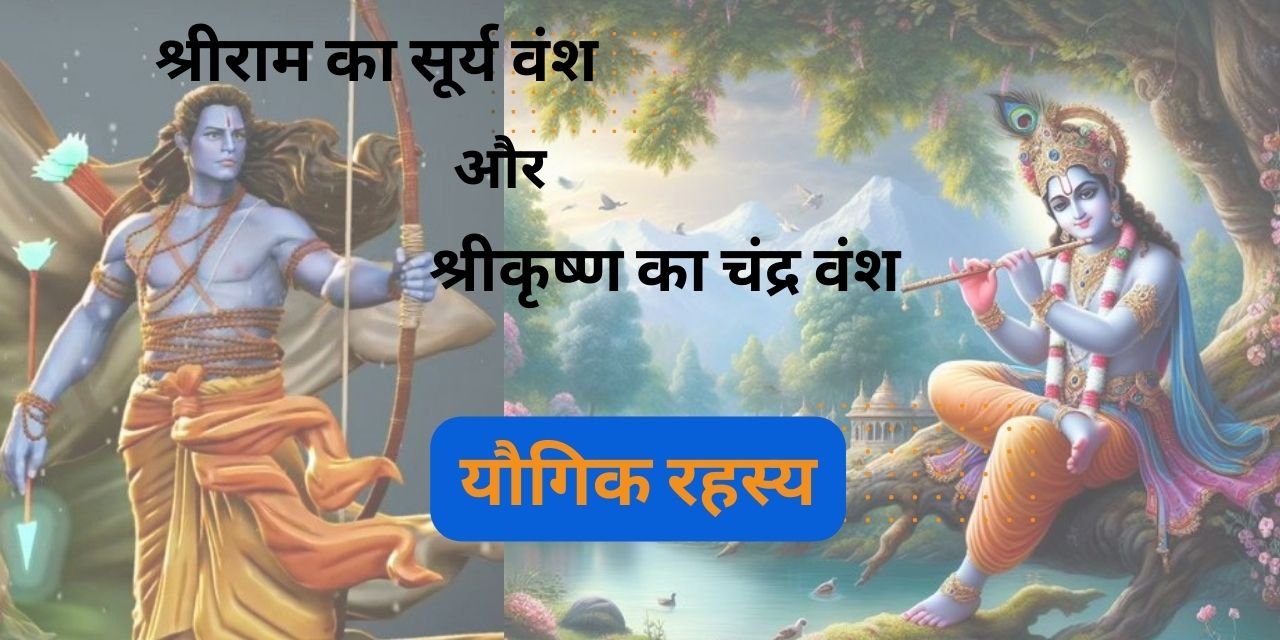
Surya Vansh of Shri Ram and Chandra Vansh of Shri Krishna: Discovery of Puranic Lineage

Surya Vansh of Shri Ram and Chandra Vansh of Shri Krishna: Discovery of Puranic Lineage

In the stories of Ramayana or Mahabharata, the characters of Rama and Krishna stand as iconic figures, revered for their wisdom, bravery and divine qualities. Interestingly, the traditional legend links their descent from various celestial bodies or stars or planets, with Rama considered to be descended from the Sun and Krishna from the Moon. This divine lineage adds different symbols and multidimensional layers of meaning to his stories, which reflects the rich thinking of our cosmology.

Rama, the seventh incarnation of Lord Vishnu, is often called 'Maryada Purushottam', an example of an ideal man. According to Hindu mythology, Rama's lineage traces back to the Sun God, Rama. This solar lineage symbolizes qualities like righteousness, duty and unwavering commitment. The life of Rama, as depicted in the epic Ramayana, unfolds with a sense of duty and adherence to dharma, reflecting the bright and disciplined nature of Surya.

Also from the yogic perspective, the Sun represents the life force or prana. All those practices under Surya come which try to move forward with only life force, ignoring mental tendencies. After practicing such sadhanas, the mental powers or desires are automatically canceled. Discipline is the only qualification for such practices. Discipline is the only qualification for such sadhanas.

The life of Shri Ram also underlines the importance of discipline and following moral rules. Uttar Ramayana tells the story of Shri Ram abandoning his beloved wife Sita to fulfill his duties. Be it Shri Ram's exile or abandoning his wife, he considered duty above sentiment.

People who have good influence of Sun, Saturn and Mars in their horoscope can achieve progress in such Surya Sadhanas. Yoga, Pranayama, Vamachar are purely such practices.

The association with the Sun also symbolizes the light of knowledge and removal of ignorance. Rama's life's journey, marked by his adherence to truth and justice, is seen as a path illuminated by the sun's radiance, leading humanity to righteousness.

On the other hand, Krishna, the eighth incarnation of Lord Vishnu, is often depicted as a playful and charismatic cowherd. Their lineage traces back to the Moon, the Moon God being considered their ancestor. The moon symbolizes beauty, love and the repetitive nature of life. Krishna's association with the Moon underlines his charming personality and the transformative power of divine love.

From a yogic or astrological perspective, the Moon represents the mind. Moon includes all those practices which try to progress with the help of mind, thoughts and emotions without thinking about any vital activities. After practicing such sadhanas, the mental feelings reach such a level that the seeker can experience oneness with God. The feeling of devotion is the only criterion or qualification for such practices.

The life of Shri Krishna emphasizes how much he cared for his loved ones. He is willing to break the rules for the benefit of his beloved. The story of Rukmini Swayamvar tells how he broke the arrangement of Swayamvar organized by Rukmini's brother Rukmi, and eloped with her to honor her love.

People who have good influence of Moon, Mercury and Venus in their horoscope can achieve progress in such lunar practices. Devotion, faith, prayer, philosophy, philosophy are purely such practices.

 The moon also symbolizes fluctuations and impermanence. In the life of Krishna, various roles were seen – the mischievous child, the charismatic lover, the compassionate friend and the wise philosopher. These diverse aspects of Krishna's personality reflect the changing phases of the moon, reflecting the dynamic nature of existence.

The conflict between the solar lineage of Rama and the lunar lineage of Krishna reflects diverse aspects of divinity and the harmonious balance in the cosmic order. While Rama represents steadfastness and unwavering adherence to duty, Krishna symbolizes the spontaneity of love and acceptance of the flow of life.

In Hindu philosophy, both the Sun and the Moon are considered essential for maintaining balance in the universe. The solar and lunar qualities complement each other, just as the qualities of Rama and Krishna co-exist in the grand saga of our mythology. The divine lineage of these divine incarnations adds depth to their characters, providing a framework for understanding and engaging with the broader spiritual teachings underlying their stories.

 The mythological lineage of Rama and Krishna, traced back to the Sun and the Moon respectively, serves as an allegory of the multifaceted nature of divinity. Rama's solar lineage symbolizes duty, righteousness and wisdom, while Krishna's lunar lineage symbolizes love, beauty and the ever-changing nature of existence. Together, these divine lineages form a harmonious sociogram that enriches the spiritual and cultural landscape of Hindu mythology, inviting individuals to contemplate the profound teachings underlying the lives of these two revered incarnations.

Translate »