
The Sun, The Moon and The Fire

Surya, Soma, and Agni — The Inner Triad of Energy and Awareness

In the subtle language of yoga and tantra, three forces are often spoken of:

Surya (Sun), Soma (Moon), and Agni (Fire)

These are not merely cosmic bodies.
They are inner principles, active within the human system, shaping both experience and transformation.

To understand them is to understand the movement of prāṇa and the refinement of mind.


1️⃣Surya — The Radiant Outward Force

Surya, the Sun, represents:

  • activity
  • projection
  • outward movement
  • heat and dynamism

Within the body–mind:

Surya is the force that drives engagement with the world

It expresses as:

  • thinking, doing, reacting
  • outward-flowing prāṇa
  • the impulse toward action

It is necessary — without it, there is no expression.
But unchecked, it leads to:

  • restlessness
  • dispersion
  • continuous mental movement

2️⃣ Soma — The Cooling Inner Field

Soma, the Moon, is of a different nature.

It represents:

  • coolness
  • receptivity
  • stillness
  • nourishment

Within us:

Soma is the subtle mind-field, capable of reflection and calm awareness

It is not the restless mind of thoughts,
but the background capacity for quiet experience.

In its pure state:

  • it is steady
  • luminous
  • and capable of deep inwardness

3️⃣ Agni — The Transforming Fire

Between these two operates Agni, the Fire.

Agni is not merely heat — it is:

the principle of transformation

It converts:

  • gross into subtle
  • scattered into unified
  • inactive into awakened

In practice, Agni appears as:

  • intensity generated by prāṇāyāma
  • the inner heat of concentration
  • the upward-driving force within the system

4️⃣The Dynamic Relationship

These three are not separate — they form a cycle.

  • Surya → moves outward
  • Soma → holds stillness
  • Agni → transforms between them

In ordinary life:

  • Surya dominates
  • Soma remains underutilized
  • Agni operates at a basic level

The result is:

outward activity without inner integration


5️⃣ The Yogic Reversal

Yoga reverses this flow.

Through:

  • breath regulation
  • bandha (internal locks)
  • inward attention

the system begins to change:

  • outward dispersion reduces
  • Agni intensifies
  • prāṇa begins to turn inward

Now Agni no longer fuels outward action —
it begins to rise from the base.


6️⃣ When Fire Meets Moon

As this inner fire rises, it encounters Soma — the subtle mind-field.

This meeting is described symbolically as:

“heating the moon”

This does not mean disturbance.

It means:

the passive, cool field of mind is activated and transformed

What was static becomes fluid.

What was latent begins to flow.


7️⃣ The Flow of Nectar

From this transformation arises what texts call:

पीयूषधारा — the stream of nectar

This is not a physical substance.

It is experienced as:

  • a continuous, calm presence
  • effortless awareness
  • a subtle, nourishing quietude

It is neither excitement nor dullness.

It is:

a stable clarity that sustains itself


8️⃣Integration — From Movement to Stillness

Seen together:

  • Surya → outward movement
  • Agni → transformative intensity
  • Soma → stabilized awareness

When harmonized:

movement returns to stillness
and stillness becomes alive

This is the inner alchemy.


9️⃣ Final Reflection

These symbols — Sun, Moon, and Fire — are not abstract metaphors.

They describe something directly observable:

  • the way energy moves
  • the way mind responds
  • the way stillness emerges

In the beginning, there is movement.
Then, there is inward turning.
Finally, there is a quiet flow that no longer depends on effort.

In that flow:

  • nothing is forced
  • nothing is held

And awareness rests,
not as an achievement,
but as its own nature.
Similarity in Tantric Entering of Sushumna and Yogic Pratyahara

1️⃣ Relate the Experience: “Energetic Throb triggered by Yogic efforts → inward → calm awareness”

energetic inward throb → then force vanishes into calm awareness

The “energy” phase is transitional
The “calm awareness” phase is the real direction

If one gets stuck in the first, it becomes energy-experience.
If it dissolves into the second, it becomes laya.


2️⃣Question: Is this yogic experience is same as Pratyāhāra in Yoga Sutras of Patanjali?

Short answer: partially correct, but incomplete


What Patañjali says about Pratyāhāra

Yoga Sutra 2.54–55:

  • senses withdraw from objects
  • mind becomes inward

This matches:

  • प्रत्यङ्मुखत्व (inward turning) from Yogataravali Verse 6

But does it include Kuṇḍalinī, Suṣumṇā, Nāda?

No — Patañjali:

  • does not describe kuṇḍalinī
  • does not describe nāḍī system explicitly
  • avoids energetic language

He describes functional states, not mechanisms.


So how to reconcile?

Yogataravali-style Patañjali-style
prāṇa centralizes senses withdraw
kuṇḍalinī awakens mind becomes inward
suṣumṇā entry attention stabilizes
nāda appears dhāraṇā possible

👉 Same process, different language.


Correct conclusion

Pratyāhāra corresponds to the beginning of inward turning,
but your verses describe deeper energetic mechanics beyond it.


3️⃣ Kuṇḍalinī “Sleeping in Mūlādhāra” — How to Understand?

This must be handled carefully — not literally.


Traditional Statement

  • Kuṇḍalinī lies “coiled” in mūlādhāra
  • It is “asleep”
  • Awakens through sādhana

Functional Interpretation

“Sleeping” means:

prāṇa is habitually outward and scattered

  • attention goes to objects
  • energy dissipates
  • no centralization

So “sleep” = unawakened inward potential


“Mūlādhāra” means:

Not just a location.

It indicates:

the base tendency of embodiment
(survival, grounding, outward identification)


“Awakening” means:

prāṇa becomes capable of inward, upward, central movement

Not a snake rising physically.


So the statement becomes:

“Kuṇḍalinī sleeps in mūlādhāra” =
“The inward potential of prāṇa remains unused while attention is outward-bound.”


4️⃣ Role of Yogic and Mantric Effort

yogic or mantric awakening

Let’s clarify both.


Yogic (bandha, prāṇāyāma)

  • act on prāṇa directly
  • reduce dispersion
  • force centralization

→ mechanical + energetic route


Mantric (japa, nāda, attention)

  • act on mind–attention
  • refine vibration
  • unify awareness

→ subtle + cognitive route


Both lead to same point:

reduction of outward fragmentation → inward unification

Which your verses call:

  • awakening
  • suṣumṇā entry
  • laya

5️⃣ Important Correction

Do not think:

“Kuṇḍalinī is an entity that rises”

Better to understand:

It is a process of reorganization of prāṇa–attention


6️⃣ Final Synthesis

Let me compress everything clearly:

  • Sleeping kuṇḍalinī = prāṇa scattered outward
  • Awakening = prāṇa begins inward movement
  • Bandha/prāṇāyāma = tools to enable that
  • Pratyāhāra = experiential beginning of inwardness
  • Suṣumṇā = non-oscillatory state
  • Nāda = subtle continuity in that state
  • Laya = dissolution of mind

🔍 Final Question (Very Precise)

In your experience:

When the “energetic throb” happens,

does it:

  • pull attention inward without effort,
    or
  • require you to stay focused to maintain it?

That difference shows whether:

  • kuṇḍalinī is self-moving, or
  • still dependent on intentional control.
Introduction to Different Paths of Sadhana

Introduction to Different Paths of Sadhana

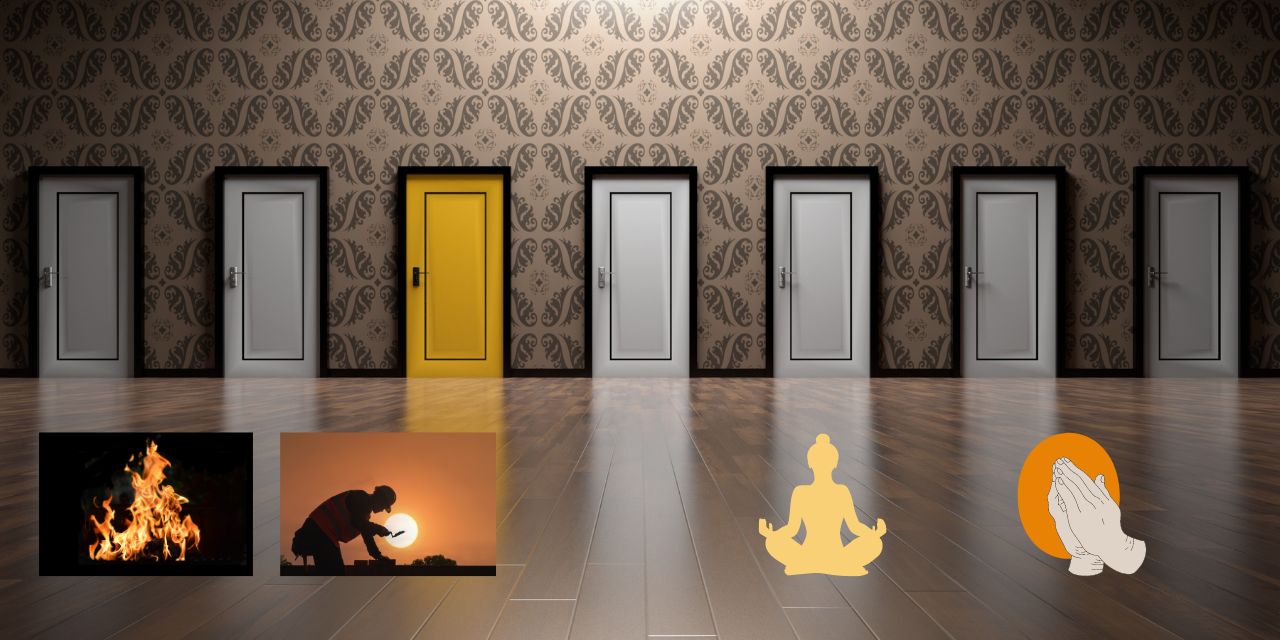
As we have seen that there are two major paths for spiritual Sadhana to achieve Moksha or deliverance. They are Karma & Samkhya. These are divided or branched out into many streams. In the  following passages, we are going to be familiar with such  different paths of Sadhana.

There are four main sub categories next to the above mentioned major paths. They are as follows

1. Jnyana 2. Bhakti 3. Yoga & Tantra 4. Karma.

Overall Idea of Spiritual Experience

Before dwelling deeper into these concepts, we would like to recall the process of spiritual experience.  With the help of Sadhana, we in general stress some of our inner content. That might be physical, mental or psychological. With persistence on the path, the devotee will start getting some feedback from those areas via  external senses,  internal  senses or mind.  As you walk on your path further ,you will start getting experience related to mind, intellect and your awareness. This is the process of spiritual experience, told in short. The devotee follows one or more paths as per his old Sanskaras or his likings.

Also we are familiar that there are four types of people who approach God. and they are as follows 1.Aarta 2. Jigyasu 3. Bhakt and 4. Jnyani.

Now we will consider the first path, that is Jnyana.

Jnyana Yoga

As we have discussed earlier, in the beginning jnyana is a karmayog.  The main instrument you utilize in this yoga is your buddhi or intellect. You apply your intellect to different revelations as postulated by your Guru or saints or scriptural truths like Mahavakyas. So what you do essentially is vicharasadhana or Sadhana of thoughts. During this process, all old Sanskars get replaced with these thoughts gradually and spiritual experience is the outcome of these thoughts and in this way experience is gained via Vicharasadhana. This experience further imparts knowledge on devotee. Devotees who can easily follow this path are jnyanayogis. But jigyasu and bhaktas, over the period of time, upgrade themselves into Jnyanayoga after getting consequent experience in their paths.

Karma Yoga

Karma is divided into sakam Karma and nishkaam Karma. Out of this, nishkam Karma is only called as karmayoga. Literal meaning of sakam is ‘with desires’ and that of nishkaam is ‘without desires’. There are three ways that Karma is being done via 5 karmendriyas. Karma means action.  And three ways of Karma are 1. action via Limbs mainly performed by body 2. action via mind. Thought itself is called Karma. 3. action via speech. If you perform action without any desire then automatically the doer of the action gets neglected, annhilited, that's ego inside of your mind gets depleted gradually and this process itself will cause laya or dissolution of your false idea of ego.& via this experience, knowledge is imparted on Karmayogi.

Bhakti Yoga

Bhakti is yoga of remembrance. By different techniques, the vicinity of God is always experienced. That method or technique may be a Mantra or Naamjapa given by Guru or any temple or Murthy -Vigrah - Statue of some deity or any natural environment or any thought. Literally it could be anything that makes devotee feel the presence of God. Here direct laya is observed, also called as Manolaya. Because in this case, you are almost devoted to your God without any condition through your deeds, your thoughts and action. In Karmayoga, yogi strive to do the karma desirelessly. In bhakti yoga, yogi does it for benefitting the presence of God. On vanishing self identification with the sense of doing any activity, gradually Karmayogi may transform himself into Bhakta. Only Bhakti alone is capable of delivering moksha but the devotees following the path of Karma & jnana And devotees belonging the category of Aarta and Jnani find this practice supportive.

Yoga & Tantra

Yoga &Tantra utilize different aspects of nature controlling or affecting the nature of an individual.  So naturally there are many substreams to yoga and tantra- for example Rajyog, Ashtanga Yoga, Mantra yoga, Kundalini yoga, Kriya yoga - all belong to this category .Tantra literally means technique so this method employees different techniques sequentially and sadhak get to know gradual transformation due to this series of techniques. Here also by pressing some of the elements of your individuality like body, mind,  or any psychological trait - bhava, experience is gained and through this experience Manolaya happens and thus presents the nature of reality to the devotee.  For a rational mind it exhibits perfect cause and effect principle so far jigyasu and jnani devotee this path is very much practical.

About the ways available to get deliverance Maharshi Patanjali says

जन्मौषधिमन्त्रतपः समाधिजाः सिद्धयः।।

ie by birth, or way of Medicines, Mantra, Tapa, or Samadhi leads to accomplishment (of moksha).

These ways considered by Maharshi Patanjali come under Yoga Tantra.

There might be other ways which I have not mentioned in this essay, but those ways will also come under the above categories. I hope this clears many of the doubts a beginner faces to understand different paths available for Moksha and to synthesize them.

Translate »