
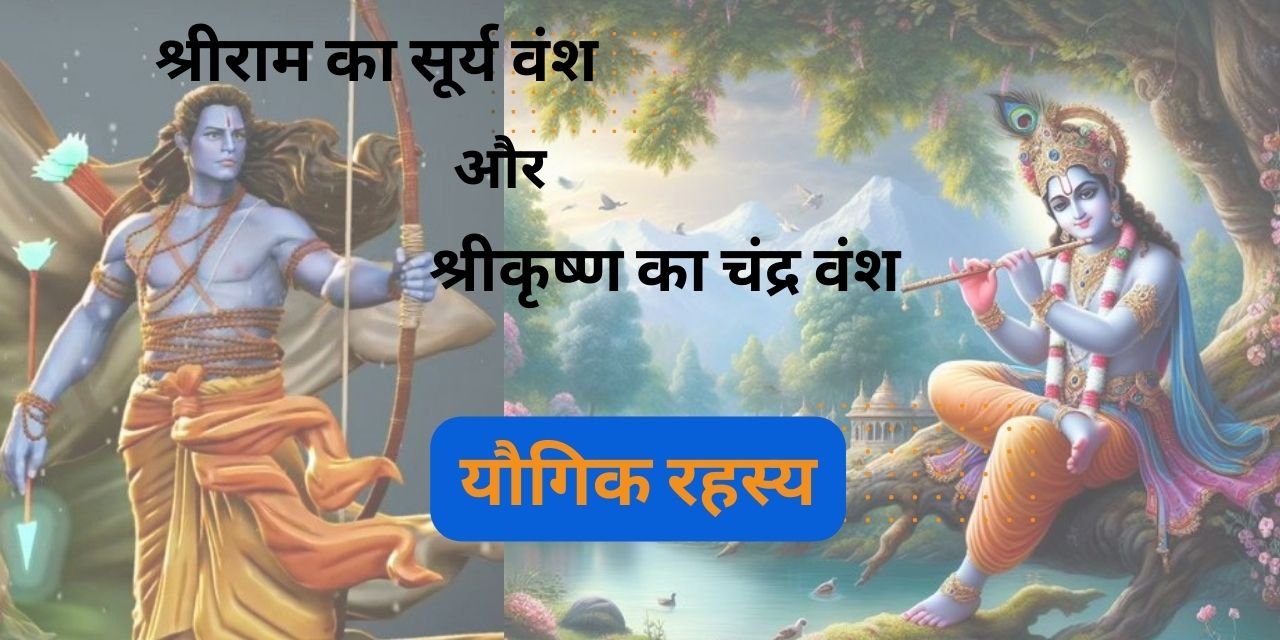
Surya Vansh of Shri Ram and Chandra Vansh of Shri Krishna: Discovery of Puranic Lineage

Surya Vansh of Shri Ram and Chandra Vansh of Shri Krishna: Discovery of Puranic Lineage

In the stories of Ramayana or Mahabharata, the characters of Rama and Krishna stand as iconic figures, revered for their wisdom, bravery and divine qualities. Interestingly, the traditional legend links their descent from various celestial bodies or stars or planets, with Rama considered to be descended from the Sun and Krishna from the Moon. This divine lineage adds different symbols and multidimensional layers of meaning to his stories, which reflects the rich thinking of our cosmology.

Rama, the seventh incarnation of Lord Vishnu, is often called 'Maryada Purushottam', an example of an ideal man. According to Hindu mythology, Rama's lineage traces back to the Sun God, Rama. This solar lineage symbolizes qualities like righteousness, duty and unwavering commitment. The life of Rama, as depicted in the epic Ramayana, unfolds with a sense of duty and adherence to dharma, reflecting the bright and disciplined nature of Surya.

Also from the yogic perspective, the Sun represents the life force or prana. All those practices under Surya come which try to move forward with only life force, ignoring mental tendencies. After practicing such sadhanas, the mental powers or desires are automatically canceled. Discipline is the only qualification for such practices. Discipline is the only qualification for such sadhanas.

The life of Shri Ram also underlines the importance of discipline and following moral rules. Uttar Ramayana tells the story of Shri Ram abandoning his beloved wife Sita to fulfill his duties. Be it Shri Ram's exile or abandoning his wife, he considered duty above sentiment.

People who have good influence of Sun, Saturn and Mars in their horoscope can achieve progress in such Surya Sadhanas. Yoga, Pranayama, Vamachar are purely such practices.

The association with the Sun also symbolizes the light of knowledge and removal of ignorance. Rama's life's journey, marked by his adherence to truth and justice, is seen as a path illuminated by the sun's radiance, leading humanity to righteousness.

On the other hand, Krishna, the eighth incarnation of Lord Vishnu, is often depicted as a playful and charismatic cowherd. Their lineage traces back to the Moon, the Moon God being considered their ancestor. The moon symbolizes beauty, love and the repetitive nature of life. Krishna's association with the Moon underlines his charming personality and the transformative power of divine love.

From a yogic or astrological perspective, the Moon represents the mind. Moon includes all those practices which try to progress with the help of mind, thoughts and emotions without thinking about any vital activities. After practicing such sadhanas, the mental feelings reach such a level that the seeker can experience oneness with God. The feeling of devotion is the only criterion or qualification for such practices.

The life of Shri Krishna emphasizes how much he cared for his loved ones. He is willing to break the rules for the benefit of his beloved. The story of Rukmini Swayamvar tells how he broke the arrangement of Swayamvar organized by Rukmini's brother Rukmi, and eloped with her to honor her love.

People who have good influence of Moon, Mercury and Venus in their horoscope can achieve progress in such lunar practices. Devotion, faith, prayer, philosophy, philosophy are purely such practices.

 The moon also symbolizes fluctuations and impermanence. In the life of Krishna, various roles were seen – the mischievous child, the charismatic lover, the compassionate friend and the wise philosopher. These diverse aspects of Krishna's personality reflect the changing phases of the moon, reflecting the dynamic nature of existence.

The conflict between the solar lineage of Rama and the lunar lineage of Krishna reflects diverse aspects of divinity and the harmonious balance in the cosmic order. While Rama represents steadfastness and unwavering adherence to duty, Krishna symbolizes the spontaneity of love and acceptance of the flow of life.

In Hindu philosophy, both the Sun and the Moon are considered essential for maintaining balance in the universe. The solar and lunar qualities complement each other, just as the qualities of Rama and Krishna co-exist in the grand saga of our mythology. The divine lineage of these divine incarnations adds depth to their characters, providing a framework for understanding and engaging with the broader spiritual teachings underlying their stories.

 The mythological lineage of Rama and Krishna, traced back to the Sun and the Moon respectively, serves as an allegory of the multifaceted nature of divinity. Rama's solar lineage symbolizes duty, righteousness and wisdom, while Krishna's lunar lineage symbolizes love, beauty and the ever-changing nature of existence. Together, these divine lineages form a harmonious sociogram that enriches the spiritual and cultural landscape of Hindu mythology, inviting individuals to contemplate the profound teachings underlying the lives of these two revered incarnations.

Introduction to Different Paths of Sadhana

Introduction to Different Paths of Sadhana

As we have seen that there are two major paths for spiritual Sadhana to achieve Moksha or deliverance. They are Karma & Samkhya. These are divided or branched out into many streams. In the  following passages, we are going to be familiar with such  different paths of Sadhana.

There are four main sub categories next to the above mentioned major paths. They are as follows

1. Jnyana 2. Bhakti 3. Yoga & Tantra 4. Karma.

Overall Idea of Spiritual Experience

Before dwelling deeper into these concepts, we would like to recall the process of spiritual experience.  With the help of Sadhana, we in general stress some of our inner content. That might be physical, mental or psychological. With persistence on the path, the devotee will start getting some feedback from those areas via  external senses,  internal  senses or mind.  As you walk on your path further ,you will start getting experience related to mind, intellect and your awareness. This is the process of spiritual experience, told in short. The devotee follows one or more paths as per his old Sanskaras or his likings.

Also we are familiar that there are four types of people who approach God. and they are as follows 1.Aarta 2. Jigyasu 3. Bhakt and 4. Jnyani.

Now we will consider the first path, that is Jnyana.

Jnyana Yoga

As we have discussed earlier, in the beginning jnyana is a karmayog.  The main instrument you utilize in this yoga is your buddhi or intellect. You apply your intellect to different revelations as postulated by your Guru or saints or scriptural truths like Mahavakyas. So what you do essentially is vicharasadhana or Sadhana of thoughts. During this process, all old Sanskars get replaced with these thoughts gradually and spiritual experience is the outcome of these thoughts and in this way experience is gained via Vicharasadhana. This experience further imparts knowledge on devotee. Devotees who can easily follow this path are jnyanayogis. But jigyasu and bhaktas, over the period of time, upgrade themselves into Jnyanayoga after getting consequent experience in their paths.

Karma Yoga

Karma is divided into sakam Karma and nishkaam Karma. Out of this, nishkam Karma is only called as karmayoga. Literal meaning of sakam is ‘with desires’ and that of nishkaam is ‘without desires’. There are three ways that Karma is being done via 5 karmendriyas. Karma means action.  And three ways of Karma are 1. action via Limbs mainly performed by body 2. action via mind. Thought itself is called Karma. 3. action via speech. If you perform action without any desire then automatically the doer of the action gets neglected, annhilited, that's ego inside of your mind gets depleted gradually and this process itself will cause laya or dissolution of your false idea of ego.& via this experience, knowledge is imparted on Karmayogi.

Bhakti Yoga

Bhakti is yoga of remembrance. By different techniques, the vicinity of God is always experienced. That method or technique may be a Mantra or Naamjapa given by Guru or any temple or Murthy -Vigrah - Statue of some deity or any natural environment or any thought. Literally it could be anything that makes devotee feel the presence of God. Here direct laya is observed, also called as Manolaya. Because in this case, you are almost devoted to your God without any condition through your deeds, your thoughts and action. In Karmayoga, yogi strive to do the karma desirelessly. In bhakti yoga, yogi does it for benefitting the presence of God. On vanishing self identification with the sense of doing any activity, gradually Karmayogi may transform himself into Bhakta. Only Bhakti alone is capable of delivering moksha but the devotees following the path of Karma & jnana And devotees belonging the category of Aarta and Jnani find this practice supportive.

Yoga & Tantra

Yoga &Tantra utilize different aspects of nature controlling or affecting the nature of an individual.  So naturally there are many substreams to yoga and tantra- for example Rajyog, Ashtanga Yoga, Mantra yoga, Kundalini yoga, Kriya yoga - all belong to this category .Tantra literally means technique so this method employees different techniques sequentially and sadhak get to know gradual transformation due to this series of techniques. Here also by pressing some of the elements of your individuality like body, mind,  or any psychological trait - bhava, experience is gained and through this experience Manolaya happens and thus presents the nature of reality to the devotee.  For a rational mind it exhibits perfect cause and effect principle so far jigyasu and jnani devotee this path is very much practical.

About the ways available to get deliverance Maharshi Patanjali says

जन्मौषधिमन्त्रतपः समाधिजाः सिद्धयः।।

ie by birth, or way of Medicines, Mantra, Tapa, or Samadhi leads to accomplishment (of moksha).

These ways considered by Maharshi Patanjali come under Yoga Tantra.

There might be other ways which I have not mentioned in this essay, but those ways will also come under the above categories. I hope this clears many of the doubts a beginner faces to understand different paths available for Moksha and to synthesize them.

Spiritual Experience without believing GOD

Spiritual Experience without believing GOD

In spiritual or religious realm belief plays very crucial role. It has its own pros and cons of believing or nonbelieving the existence of God. But there is a way of Godless Enlightenment where devotee can have spiritual experience without believing God.

Belief offers soothing, composed psychological environment to Sadhaka. He can achieve interiorization faster if his mental or psychological faculties called as Bhava are immersed in Belief. But Belief may not be rational, may not be practical at all. Or sometimes it does not consider wellbeing of surrounding community. So, it offers some sort of alien craze to sadhaka on which he/she tries to ride to reach the Experience. This is one of the ways to achieve deliverance.

But the question is if any path exists to reach the experience which does not depend on belief system at all? And fortunately, the answer is great YES.

Yoga, I believe, is the only path where belief does not intermingle with your method of experiments and experiences thereon. If you want to mix yoga with some tantra or some belief system then its different story. But its very much true that you can have a system where you can experiment with your body and mind. And you will be landed in commonly forbidden area of awareness and there you can find evidences about the existence of God keeping whole of your belief system aside. The experiences of Yoga only will tell you the truth. We call these experiences as Yogaj Anubhava, which literally means Experiences derived from the practice of Yoga. No assumptions are required. Only some of the things which are part of your yoga routine is required to be followed steadfastly until you get deliverance.

So really what is the need of belief system if you want to bypass it and still reach the essence of Truth? You might ask this question next moment. The answer is your qualification or compatibility with the path of Yoga. This path is somewhat dry, avoiding all the cobwebs of feeling and emotions. Approach of scientist, performing sadhana like an experiment and observe your mind, awareness, your inner being for its effects are essential qualities to tread this path. Overwhelming hope for future is absent here, you do not predict what will happen next. Though you know the experiences of your seniors on this path, when those things happen to you, same alien awareness will envelope your being until you assimilate it fully over the time. If you have this temperament then you can easily tread this path of yoga. And reach the enlightenment without depending on any belief system.

You can call this path of yoga utilizing your breath as object for your concentration, ie you do your sadhana karma with your breath. Slowly over the period of time, your mind will get along with your breath. As with more practice, your breath will slow down making your mind calm & tranquil. This creates the opportunity for Laya or Manolaya. For some devotees merely interiorization leads to this Laya. Sublimating mind in its own stuff. Path of mantra or devotion to any deity also leads to Manolaya which will annihilate your sense of existence and will awaken you in the realm of omni conscious, ever joyful, deathless awareness.

For the sake of introduction, I have jotted down the whole process in few lines. Many experiences can occur along the path indicating your status on this journey. This journey can continue for months, or for some years or for some lifetimes.

Some people call this as Godless path of Enlightenment. Maybe Buddha who did not answer the question whether God exists for his whole lifetime, wanted to indicate towards this path. So really you have answer now and you are capable to take your own decision about implementing belief or treading beyond.

Thiest, Athiest or something else

Thiest, Athiest or something else

As the subject mentions, we are going to discuss about theists, atheist or is there any third way of knowledge about existence of God and related phenomena.
In general, we categorise people among these groups, the people who believe in their God or his existence and other people who don't believe in it. You might have come across the concept that this both categories are nothing but same and there is chance that something else does exist.
Now first of all, we want to concentrate or focus on the fact that why it is called as believers and nonbelievers are two sides of same coin. Also,one thing you might have noticed that believers believe that God exist, whereas atheist believe that God does not exist . Now check closely the fact that both these categories assumes something whether it is existence or non-existence about the God. None of the parties have made any experiment to confirm their claim about God being him as existant or non existant. This is how it has been explained that both believers and non-believers of God are on same side who do not make any experiment and without any evidence they have started assuming something taking some scripture or messages of some messenger as a standard.

Next point is, there are some traditions or groups who make experiment, find observations and reach out to some concrete inferences. There also you will find that non-believers exist in such group. Now how you look at this? Basically what has happened is the group of people or devotees, following their traditions have recorded the same experiences, but they have interpreted them differently. This is another point wherein evidence-based system also has reached to the result about existence or non-existence of God.

But there is one thing for sure if you follow the opinions of believers or non-believers who do not make any experiments, and without any reason after getting their minds conditioned due to some reasons, you also might fall in the categories of blind believers. If you start believing on their interpretations and inferences of experiment made by the traditions or devotees of that particular path - Then also you do not have any evidence-based opinion on your own because what ever the experiences and their inferences collected by that group of people about existence or non-existence of God is rather surreal. So these results cannot be exhibited to the public in open. In Modern scientific world , still many are trying, but the fact has remained secret since ages.

So it's best that you do not take the side of any of that two but start your experiments on your own wherein your body and your mind is your laboratory and experience is derived in this laboratory through the experiments of Sadhana which can make you reach to some experiences and their inferences. In this case, you have will the right to interpret all those experience on your own also you have a better chance and a responsibility to present those experiments with their interpretations without any political dogma and you will have confidence in your observations ..

विषया विनिवर्तन्ते निराहारस्य देहिनः।

रसवर्जं रसोऽप्यस्य परं दृष्ट्वा निवर्तते।।2.59।।

We will take one Bhagwat Gita Shloka for reference. The complete meaning for this Shloka has been given as below.

The object of senses will become irrelevant(, but does not get lost) who has followed the practice of Neerahaara and when such devotee gets the vision of the ultimate, the desires and attractions inherent to these objects of senses will get vanished.

we want to put your focus to words 'परं दृष्ट्वा' pronounced as 'Param Drashtva'. This has been clearly indicated in this Shloka, that the ultimate can be brought into a vision. You can see him in some form so the existence which is beyond the range of your senses can be brought into Such range. So if our Scriptures and the experiences of our ancient people support this phenomena then it is worth while to think that when there is a possibility to have a vision or confirmation about existence of God, then why it is necessary to believe on something or sayings of some people.

In conclusion, I would like to make only one point that the human should make all his effort to derive this experience which will lead him to the knowledge instead of putting himself into the conservative belief system. You can bypass this belief system when you have your own experience.

2 Major Paths of Sadhana

2 Major Paths of Sadhana

There are only two paths of Spiritual progress. That's what Bhagwad geeta says in its 3rd Adhyaya. And those are Karma and Samkhya ie Jnyana. Everybody is qualified for path of Karma because whoever has Karmendriyas that is 5 organs of karma, he will be able to follow the path of Karma.

But its not the same for Jnyana. You need to qualify the threshold level of Logic, open mindedness to pursue on this path. Though you have inclination or interest in this path, still you have to do karma. One more tricky thing about this paths is that if you are layman doing his karma religiously with his fullest efficiency with whatever skill he possess, he will get entry into Jnyana.

So Karma Sadhanas are being done with five organs of Karma. But Jnyana Yoga is being done with only one organ ie.mind.

But if you are follower of opinion that on broader terms Karma is being done on three levels , by Kaya-Vacha-Manasa i.e by body, by speech & by mind, Then Jnyana as a Karma to be done by mind and intellect becomes part of Karma Yoga only. So you have only one path for spiritual progress and that is Karma.

In this perspective, three things namely Karma, Jnyana as sadhana or Jyana Yoga, and Jnyana as a object should be distinguished and to be understood by sadhaka very clearly, in the beginning itself.

Followers of Jnyana yoga doing their sadhana with mahavakyas , Upanishadas or NirvanTrayi assume whatever written in those books is required to be made by heart, that is what ultimate crux of reality is. Seldom they end in lipstick vedanta and start assuming this is what sadhana and its fulfilment is.

Ashtang yoga as told by Patanjali, mantra yoga, Bhakti yoga, tantra yoga even Kriya yoga and many different types of Yogas are all Karma Yogas. They are all called as Anvopaya ie very little means of Karmic effort.  Jnyana yoga also starts with karma, A karma of Vichara or Vichara Sadhana.

After initial substantial efforts in Karma, the sadhaka receives some spiritual experience. This experience imparts some knowledge, veil above his identity is removed for a instance, But that glance is so addictive that the sadhaka wants to reach that state again and again. This experience is the function of the tradition a Sadhaka follows or type of Yoga he does. Then actually he decides which is his real path.

In Karma yoga such experiences help sadhaka to annihilate karma samskaras but in Jnyana yoga habit of Logic and rational mind is used to change inclinations of mind and thereby slowly as you progress on the path age-old karma samskaras loosen their grip.

So spiritual experience is not the essential requirement of Jnyana yoga so you are now clear as why it is said that a Guru is must for all Karmic Paths. You need an experience to impart the knowledge or   reveal some aspect of reality. So you need proven path of methods and procedures, that’s what Guru donates. In some traditions Guru directly imparts Spiritual Experience called as Shaktipaat. But Jnyana Yoga is not adhered with such requirement of experience. Rather in some traditions of Jnyana Yoga such experiences are treated as mayic or materialistic. So Jnyana yoga or any yoga treated with the methods of Jnyana Yoga doe not need a Guru.

For some sadhakas , they get experience in one path still the attraction for other does not vanishes. They have such Karmic patterns and Samskaras. They need to follow different paths as their Karmic bandhanas unfolds, as their samskaras spring up from their inner being.

So you find there are many paths for your spiritual unfoldment, and also you can find people talking about taking different paths in single lifetime.

Translate »