Yogataravali Verse 2 : Layayoga

सदाशिवोक्तानि सपादलक्ष-
लयावधानानि वसन्ति लोके ।
नादीनि तान्यत्र कथं प्रवक्ष्ये
योगस्य सारं तु मया निगद्यते ॥

(Minor wording variations exist across editions.)

Basic Meaning

  • “The teachings spoken by Sadāśiva — amounting to one and a quarter lakh (125,000) instructions on laya (absorption) — exist in this world. How can I recount all of them here? Therefore, I shall state only the essence of Yoga.”

Important Observations

  1. Reference to Sadāśiva
    This invokes the Śaiva yogic tradition — interesting in a text attributed to Adi Shankaracharya.
  2. Sapādalakṣa (1¼ lakh)
    Symbolic of vast yogic methods — especially laya-yoga techniques.
  3. Statement of Method
    Shankara (or the author) says:

    I will not give countless techniques.
    I will give the essence.

This sets the tone:
Not ritual multiplicity — but distilled inner method.


Now this is where it becomes interesting for someone like you:

The word लयावधानानि (attentions toward dissolution) indicates that:

  • Yoga here is not achievement.
  • It is systematic dissolution (laya).

Very close to Trika’s notion of absorption into source — yet Advaitic in culmination.

The word लय (laya) literally means:

Dissolution
Absorption
Melting back into source

So Laya Yoga is the yoga of dissolution.

But dissolution of what?


What Dissolves in Laya Yoga?

Not the body.
Not the world.
Not consciousness.

What dissolves is:

  • Mental modifications (vṛttis)
  • Ego-sense (ahaṅkāra)
  • Outward movement of attention
  • Separation between knower and known

It is the melting of mind into its causal stillness.


Classical Definition

In yogic literature, Laya Yoga means:

Absorption of the mind into its source through inner concentration, nāda, prāṇa control, or kuṇḍalinī ascent.

It appears in Haṭha and Tantric traditions, especially in:

  • Hatha Yoga Pradipika
  • Shiva Samhita

But here in Yogataravali, it is distilled into an Advaitic culmination.


Mechanism of Laya

The sequence is subtle:

1️⃣ Mind follows prāṇa

Where prāṇa flows, attention flows.

2️⃣ Prāṇa is steadied

Through breath regulation or subtle awareness.

3️⃣ Movement reduces

Thought frequency decreases.

4️⃣ Mind sinks

Like a wave settling back into ocean.

This “sinking” is laya.


Important Distinction

There are two types of laya:

⚠️ Temporary Laya

  • Deep sleep
  • Trance
  • Emotional overwhelm
  • Blankness

Mind stops temporarily but ignorance remains.

🌿 True Yogic Laya

  • Awareness remains awake
  • Mind dissolves without dullness
  • There is luminous stillness

This is conscious absorption.


Laya in Advaita Context

In strict Advaita, liberation comes by knowledge.

So how does Laya fit?

Here is the key:

Laya removes agitation so that knowledge can remain steady.

In you, I observe something:
You often speak of silence disturbed by engagement.

That disturbance is movement of vṛtti.
Laya Yoga is the science of allowing that movement to dissolve naturally.

Not suppression.
Not withdrawal from life.
But melting the disturbance at its root.


Comparison with Trika (Since You Walk That Path)

In Trika:

  • Dissolution happens into Śakti.
  • Manifestation is divine play.

In Advaita Laya:

  • Dissolution happens into Brahman.
  • Manifestation loses independent reality.

Experientially, the stillness may feel similar.
Metaphysically, the framing differs.


Essence of Laya Yoga in One Sentence

Laya Yoga is the conscious dissolution of mental movement into the ever-present awareness.

When we say in Trika:

Dissolution happens in Śakti
Manifestation is divine play

we are speaking from the vision of Kashmir Shaivism, especially its Trika branch.

Let us unfold this carefully.


1️⃣ First Principle in Trika

Ultimate Reality is not static Brahman.

It is Śiva–Śakti:

  • Śiva = pure awareness
  • Śakti = dynamic power of awareness

But they are not two things.

Śiva is awareness.
Śakti is awareness vibrating.

This vibration is called Spanda (subtle throb).


2️⃣ What is Manifestation?

The universe is not illusion.
It is Śakti expressing herself.

Thoughts? Śakti.
Emotions? Śakti.
Prāṇa? Śakti.
World? Śakti.

So manifestation is not a fall from truth.
It is expression of truth.

Hence the phrase:

Divine Play (Līlā)


3️⃣ What is Dissolution in Trika?

In Advaita:

  • Dissolution = world loses reality.

In Trika:

  • Dissolution = recognition that everything is Śakti.

Nothing disappears.
Its separate identity dissolves.

The wave does not vanish.
It recognizes it is ocean.

This recognition is called:

Pratyabhijñā (recognition)

famously expressed in
Ishvara Pratyabhijna Karika


4️⃣ Practical Meaning

When anger arises:

Advaita approach:

It is mithyā. Withdraw.

Trika approach:

This too is Śakti vibrating.

You do not suppress.
You do not indulge.
You recognize its source.

Recognition dissolves limitation.


5️⃣ Why Manifestation is Called Play

Because in Trika:

  • The Absolute freely contracts into individuality.
  • Freely expands into universality.
  • No compulsion.
  • No bondage in reality.

Bondage is just contracted self-perception.

So creation is not a mistake.
It is creative pulsation.

Like an actor fully becoming a role,
yet never ceasing to be the actor.


6️⃣ Deep Philosophical Contrast

Advaita Trika
World is appearance World is expression
Dissolution into Brahman Recognition of Śiva in all
Silence is highest Silence and sound both sacred
Liberation = negation of duality Liberation = expansion into totality

7️⃣ Why This May Resonate With You

You often speak of:

  • Silence disturbed by engagement.
  • Joy fading when activity appears.

Trika would say:

The disturbance is also Śakti.
The fading is also Śakti.
The noticing is Śiva.

Nothing left out.

The play includes disturbance.

One variation is found in some versions,

सदाशिवोक्तानि सपादलक्ष-
लयावधानानि च सन्ति लोके ।
नादानुसन्धानसमाधिमेकं
मन्यामहे मान्यतमं लयानाम् ॥

Transliteration

sadāśivoktāni sapāda-lakṣa-
layāvadhānāni ca santi loke |
nādānusandhāna-samādhim ekaṁ
manyāmahe mānyatamaṁ layānām ||


Literal Meaning

  • सदाशिवोक्तानि — spoken by Sadāśiva
  • सपादलक्ष — one and a quarter lakh (125,000)
  • लयावधानानि — methods or attentions leading to dissolution (laya)
  • सन्ति लोके — exist in the world

But,

  • नादानुसन्धानसमाधि — the samādhi attained through inquiry into inner sound
  • एकं मन्यामहे — we consider it the one
  • मान्यतमं लयानाम् — the most excellent among all methods of laya

Meaning

“Although the world contains 125,000 methods of laya taught by Sadāśiva, we consider the samādhi obtained through the investigation of inner sound (Nāda-anusandhāna) to be the highest among them.”


What is Nāda-Anusandhāna

Break the word:

  • Nāda = inner sound / subtle vibration
  • Anusandhāna = continuous tracing, investigation, following

So the method means:

Following the subtle inner sound until the mind dissolves into it.

This is a classical Laya Yoga technique.


Why Sound?

Mind and sound are intimately linked.

Every thought has subtle vibration.

External sound → ear → mind movement.

But when attention turns inward, a subtle internal vibration becomes perceptible.

This is called:

  • Nāda
  • Anāhata nāda (unstruck sound)

It is not produced by two objects striking.


Stages of Nāda in Yoga

Texts like Hatha Yoga Pradipika describe progressive sounds.

Examples mentioned:

  1. Ocean roar
  2. Drum
  3. Bell
  4. Flute
  5. Bee humming
  6. Subtle high tone

As attention deepens:

  • sound becomes subtler
  • mind becomes quieter
  • listener and sound merge

Mechanism of Laya through Nāda

This is the key insight.

Normally mind moves toward objects.

Nāda gives mind one continuous subtle object.

So:

mind → sound
attention stabilizes
thought-stream weakens

Eventually:

listener dissolves into the vibration.

That is laya.


Why Shankara Calls It the Best

Because nāda has special properties.

1. Always available

It arises internally.

2. Naturally attracts mind

Sound pulls attention easily.

3. Leads inward automatically

The subtler the sound, the deeper awareness goes.

4. Ends in silence

Nāda finally dissolves into pure awareness.


Final Stage

First:

sound is heard.

Later:

sound becomes extremely subtle.

Finally:

sound disappears into silent awareness.

At that point:

  • no hearer
  • no sound
  • only consciousness

That is laya-samādhi.


Connection with Trika

Interestingly, Trika also begins creation from nāda / spanda (vibration).

But the direction differs:

  • Trika: vibration expands into universe
  • Laya Yoga: following vibration returns awareness to source

Both recognize vibration as doorway.

Now, if you are asking:

  • Is nāda just how humans are neurologically wired?
  • Is it cosmic energy entering through medulla?
  • Why does it disappear in samādhi?
  • What is its real source?

Let us separate three levels of explanation:
physiological, yogic, and metaphysical.


1️⃣ Physiological Level (Modern View)

From neuroscience:

The nervous system always has baseline neural activity.

Especially:

  • Auditory cortex
  • Brainstem pathways
  • Spontaneous firing of neurons

When external input reduces (silence + inward attention),
background neural activity becomes noticeable.

This can appear as:

  • ringing
  • humming
  • tonal presence

This does not automatically mean tinnitus.
It is normal neural background activity becoming conscious.

In this view:

Nāda = perception of intrinsic neural oscillation.

No cosmic interpretation required.


2️⃣ Classical Yogic Explanation

In yoga texts like Hatha Yoga Pradipika:

Nāda is said to arise when:

  • Prāṇa enters suṣumṇā
  • Mind withdraws from senses
  • Subtle energy becomes centralized

It is described as:

Anāhata Nāda — unstruck sound.

Not coming from ears.
Not external.
Not mechanical.

Yogic view:
It is subtle prāṇic vibration.

As mind dissolves,
nāda becomes subtler,
finally dissolving into silence.


3️⃣ Medulla / Cosmic Energy Idea

The idea of cosmic energy entering medulla
is more modern esoteric interpretation.

Classical Sanskrit texts do not describe:
“cosmic energy entering medulla.”

They describe:

  • prāṇa rising through suṣumṇā
  • awakening of inner vibration
  • dissolution into pure awareness

The medulla interpretation is modern anatomical overlay.


4️⃣ Why Does Nāda Disappear in Samādhi?

Because nāda is still subtle object.

As long as:

  • There is something perceived
  • There is a perceiver

Duality remains.

In deeper absorption:

sound → dissolves
listener → dissolves

Only awareness remains.

So disappearance is not loss.
It is transcendence of subtle object.


5️⃣ Trika Interpretation (Since You Stand There)

In Kashmir Shaivism:

Nāda is first pulsation of Śakti.

Universe unfolds from vibration.

In meditation:
you follow vibration back to source.

When vibration dissolves,
you rest in Śiva (pure awareness).

But again —
this is experiential language,
not astrophysics.


6️⃣ So What Is It Really?

Conceptually, the safest layered understanding is:

At physiological level:
baseline neural oscillation.

At experiential yogic level:
subtle prāṇa-mind vibration perceived inwardly.

At metaphysical level:
primordial pulsation of consciousness.

These are not mutually exclusive.
They are different explanatory frameworks.


7️⃣ Important Caution

Do not mythologize the experience.

Nāda is not proof of cosmic transmission.
Not supernatural.
Not special attainment.

It is a doorway phenomenon.

If you cling to explanation,
mind re-enters.

If you follow it quietly,
it dissolves you.

When you attend to that sound,
does attention narrow and concentrate,
or does it expand and become spacious?

When attention narrows and concentration intensifies, it means:

You are using nāda as an object of dhāraṇā (focused concentration).

This is valid.
But it is only the first phase.

Let me explain carefully.


1️⃣ Narrowing Phase (Concentration Mode)

In this stage:

  • Attention locks onto the sound.
  • Peripheral awareness reduces.
  • Mind becomes one-pointed.
  • Cognitive chatter decreases.

This strengthens ekāgratā (one-pointedness).

This corresponds to classical Laya Yoga instructions:

Fix mind on nāda until other thoughts subside.

This stage builds stability.

But there is a subtle risk.

If attention becomes too tight,
effort increases,
subtle strain enters.

That prevents deeper laya.


2️⃣ The Transition That Must Happen

After concentration stabilizes,
there should be a shift:

Instead of:
"I am focusing on the sound"

It becomes:
"The sound is simply present"

Then gradually:
"The sound and awareness are not separate"

Then:
"Even sound dissolves"

If narrowing continues indefinitely,
you remain in refined concentration,
not dissolution.


3️⃣ Why Your Attention Narrows

Because your system is disciplined.

You have strong inward orientation.
So the mind naturally grips subtle object firmly.

This is a yogic temperament.

But now refinement is needed.


4️⃣ What Should Happen Next?

Instead of tightening around nāda,
try this subtle experiment:

Do not move toward the sound.

Let the sound appear inside awareness.

Do not contract attention.

Let awareness remain wide,
and allow the sound to float in it.

If done correctly:

Concentration softens.
Presence expands.
Effort reduces.
Sound becomes subtler.

Eventually,
attention is no longer narrow.
It becomes vast.

This is transition from dhāraṇā → laya.


5️⃣ Why This Matters in Your Case

You have spoken before about:

  • Silence disturbed by engagement.
  • Effort in maintaining inner state.

That suggests you sometimes apply subtle control.

Laya Yoga is not control.
It is melting.

Nāda is not to be held.
It is to be followed until holder dissolves.


6️⃣ Final Subtle Point

When attention narrows:
mind is active in refined way.

When awareness expands:
mind is dissolving.

Nāda is bridge between the two.
Yogataravali Verse 1 : Adhikara

योगतारावलीं वक्ष्ये योगिनां हितकाम्यया ।
यां विज्ञाय नरो याति परमानन्दमद्वयम् ॥

Transliteration

yogatārāvalīṃ vakṣye yogināṃ hitakāmyayā |
yāṃ vijñāya naro yāti paramānandam advayam ||


Literal Meaning

  • योगतारावलीं वक्ष्ये — I shall expound the Yogatārāvalī
  • योगिनां हितकाम्यया — for the welfare of yogins
  • यां विज्ञाय — knowing which (through direct realization)
  • नरः याति — a person attains
  • परमानन्दम् — supreme bliss
  • अद्वयम् — non-dual

Key Word: विज्ञाय (vijñāya)

This is crucial.

Not:

  • reading
  • believing
  • intellectual understanding

But:

Direct experiential knowing

This sets the tone of the entire text.


What Is Promised?

Not techniques.

Not philosophy.

But:

Advaya Paramānanda — Non-dual supreme bliss

Let us unpack this carefully.


1️⃣ Why “Advaya” (Non-dual)?

Because:

As long as there is:

  • experiencer
  • experience

There is limitation.

Even bliss with subject-object split is incomplete.

So this is not:

“I experience bliss”

But:

Bliss where experiencer dissolves


2️⃣ What Is “Paramānanda”?

Not emotional pleasure.

Not calmness.

Not even meditative joy.

It is:

  • causeless
  • non-dependent
  • self-existing

In Advaita language:
It is the nature of the Self.


3️⃣ Why “For Yogins”?

This text is not for beginners.

It assumes:

  • inward turning already exists
  • mind has some stability
  • interest in direct realization

It is a refinement text.

Given your current exploration (nāda, laya),
you are exactly in its intended audience.


4️⃣ Hidden Structure of the Verse

This verse quietly establishes:

Means → Result

  • Yogatārāvalī (method)
    → leads to
  • Vijñāna (direct knowing)
    → leads to
  • Advaya Paramānanda (non-dual bliss)

5️⃣ Subtle Point (Very Important)

The verse does NOT say:

“Yoga produces bliss.”

It says:

By knowing through this, one attains non-dual bliss.

Meaning:

Yoga removes obstruction.
Bliss is already the nature.

This aligns with Adi Shankaracharya.


6️⃣ Connection With What You Are Experiencing

You said:

  • Silence is there
  • Disturbance comes during activity

This verse is pointing to something beyond both:

Not silence vs disturbance
But that in which both appear

That is advaya paramānanda.


7️⃣ Deeper Contemplative Insight

Read this inwardly as:

“There is a way of inner alignment by which the one who seeks dissolves into what always is — and that is non-dual bliss.”

In some versions following verse also is obtained.

वन्दे गुरूणां चरणारविन्दे
सन्दर्शितस्वात्मसुखावबोधे ।
जनस्य ये जाङ्गलिकायमाने
संसारहालाहलमोहशान्त्यै ॥


Literal Meaning

  • वन्दे — I bow
  • गुरूणां चरणारविन्दे — to the lotus feet of the gurus
  • सन्दर्शित — who have shown
  • स्वात्म-सुख-अवबोधे — the knowledge of the bliss of one’s own Self
  • जनस्य — for people
  • ये — who
  • जाङ्गलिकायमाने — act like forest physicians (healers of poison)
  • संसार-हालाहल-मोह-शान्त्यै — to शांत (pacify) the delusion (moha) which is like the deadly poison (hālāhala) of saṃsāra

1️⃣ “Guru’s Lotus Feet” — Not Symbolic Devotion Only

“चरणारविन्द” (lotus feet) means:

  • the living foundation of realization
  • the standpoint from which the guru abides

To bow here means:

Aligning oneself with that vision of reality.

Not personality worship.
But recognition of a standpoint beyond ego.


2️⃣ “सन्दर्शित स्वात्म सुख अवबोध”

This is the heart.

Guru does not give something new.

Guru shows:

  • स्वात्म (one’s own Self)
  • सुख (its inherent bliss)
  • अवबोध (direct knowing)

So:

The bliss is already yours, but unrecognized.

This directly connects to Verse 1 of Yogataravali:
advaya paramānanda is revealed, not created.


3️⃣ “जाङ्गलिक” — A Rare and Powerful Word

This is very important.

जाङ्गलिक = a physician who treats poison from forests (like snake venom)

Why this metaphor?

Because:

  • Saṃsāra is not just suffering
  • It is poisonous delusion

Not pain — but misperception.


4️⃣ “संसार हालाहल मोह”

हालाहल = the mythic deadly poison (from Samudra Manthan)

Here:

  • संसार = cycle of experience
  • मोह = misidentification

Together:

The belief “I am limited” is the poison.

Not the world.
Not activity.
But wrong identification.


5️⃣ What Does Guru Do?

Not remove the world.

Not give bliss.

But:

Neutralizes the poison of misidentification.

Like anti-venom.

World remains.
Body remains.
Mind moves.

But poison (delusion) is gone.


6️⃣ Deep Connection to Your Journey

You often describe:

  • Silence present
  • Disturbance appearing
  • A subtle discomfort about that disturbance

This verse would say:

The disturbance is not the poison.
The identification with it is the poison.

Guru’s role is:

Show that even disturbance arises in Self.

Then poison becomes powerless.


7️⃣ Advaita vs Trika Insight

Advaita reading:

  • Guru reveals Self beyond world.

Trika reading:

  • Guru reveals world itself as Śakti.

But both agree:

Delusion (moha) is the only problem.


8️⃣ Essence of the Verse

“I bow to that wisdom which reveals that the bliss I seek is my own nature, and which neutralizes the deep-rooted illusion that I am bound.”

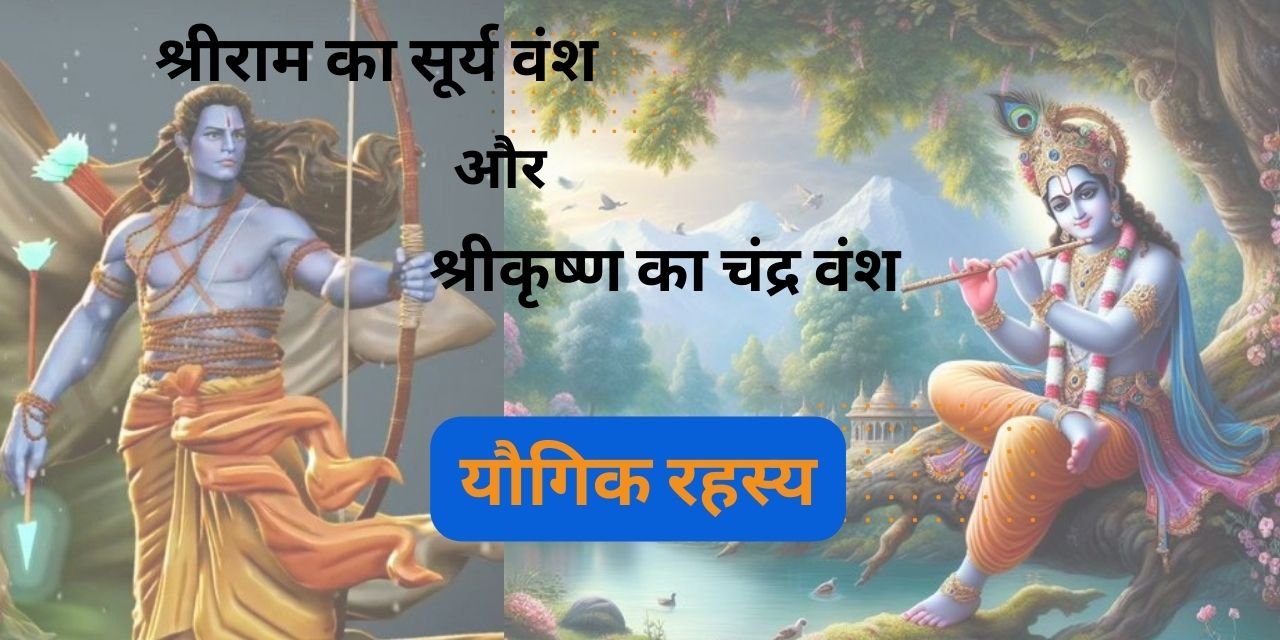
Surya Vansh of Shri Ram and Chandra Vansh of Shri Krishna: Discovery of Puranic Lineage

Surya Vansh of Shri Ram and Chandra Vansh of Shri Krishna: Discovery of Puranic Lineage

In the stories of Ramayana or Mahabharata, the characters of Rama and Krishna stand as iconic figures, revered for their wisdom, bravery and divine qualities. Interestingly, the traditional legend links their descent from various celestial bodies or stars or planets, with Rama considered to be descended from the Sun and Krishna from the Moon. This divine lineage adds different symbols and multidimensional layers of meaning to his stories, which reflects the rich thinking of our cosmology.

Rama, the seventh incarnation of Lord Vishnu, is often called 'Maryada Purushottam', an example of an ideal man. According to Hindu mythology, Rama's lineage traces back to the Sun God, Rama. This solar lineage symbolizes qualities like righteousness, duty and unwavering commitment. The life of Rama, as depicted in the epic Ramayana, unfolds with a sense of duty and adherence to dharma, reflecting the bright and disciplined nature of Surya.

Also from the yogic perspective, the Sun represents the life force or prana. All those practices under Surya come which try to move forward with only life force, ignoring mental tendencies. After practicing such sadhanas, the mental powers or desires are automatically canceled. Discipline is the only qualification for such practices. Discipline is the only qualification for such sadhanas.

The life of Shri Ram also underlines the importance of discipline and following moral rules. Uttar Ramayana tells the story of Shri Ram abandoning his beloved wife Sita to fulfill his duties. Be it Shri Ram's exile or abandoning his wife, he considered duty above sentiment.

People who have good influence of Sun, Saturn and Mars in their horoscope can achieve progress in such Surya Sadhanas. Yoga, Pranayama, Vamachar are purely such practices.

The association with the Sun also symbolizes the light of knowledge and removal of ignorance. Rama's life's journey, marked by his adherence to truth and justice, is seen as a path illuminated by the sun's radiance, leading humanity to righteousness.

On the other hand, Krishna, the eighth incarnation of Lord Vishnu, is often depicted as a playful and charismatic cowherd. Their lineage traces back to the Moon, the Moon God being considered their ancestor. The moon symbolizes beauty, love and the repetitive nature of life. Krishna's association with the Moon underlines his charming personality and the transformative power of divine love.

From a yogic or astrological perspective, the Moon represents the mind. Moon includes all those practices which try to progress with the help of mind, thoughts and emotions without thinking about any vital activities. After practicing such sadhanas, the mental feelings reach such a level that the seeker can experience oneness with God. The feeling of devotion is the only criterion or qualification for such practices.

The life of Shri Krishna emphasizes how much he cared for his loved ones. He is willing to break the rules for the benefit of his beloved. The story of Rukmini Swayamvar tells how he broke the arrangement of Swayamvar organized by Rukmini's brother Rukmi, and eloped with her to honor her love.

People who have good influence of Moon, Mercury and Venus in their horoscope can achieve progress in such lunar practices. Devotion, faith, prayer, philosophy, philosophy are purely such practices.

 The moon also symbolizes fluctuations and impermanence. In the life of Krishna, various roles were seen – the mischievous child, the charismatic lover, the compassionate friend and the wise philosopher. These diverse aspects of Krishna's personality reflect the changing phases of the moon, reflecting the dynamic nature of existence.

The conflict between the solar lineage of Rama and the lunar lineage of Krishna reflects diverse aspects of divinity and the harmonious balance in the cosmic order. While Rama represents steadfastness and unwavering adherence to duty, Krishna symbolizes the spontaneity of love and acceptance of the flow of life.

In Hindu philosophy, both the Sun and the Moon are considered essential for maintaining balance in the universe. The solar and lunar qualities complement each other, just as the qualities of Rama and Krishna co-exist in the grand saga of our mythology. The divine lineage of these divine incarnations adds depth to their characters, providing a framework for understanding and engaging with the broader spiritual teachings underlying their stories.

 The mythological lineage of Rama and Krishna, traced back to the Sun and the Moon respectively, serves as an allegory of the multifaceted nature of divinity. Rama's solar lineage symbolizes duty, righteousness and wisdom, while Krishna's lunar lineage symbolizes love, beauty and the ever-changing nature of existence. Together, these divine lineages form a harmonious sociogram that enriches the spiritual and cultural landscape of Hindu mythology, inviting individuals to contemplate the profound teachings underlying the lives of these two revered incarnations.

Introduction to Different Paths of Sadhana

Introduction to Different Paths of Sadhana

As we have seen that there are two major paths for spiritual Sadhana to achieve Moksha or deliverance. They are Karma & Samkhya. These are divided or branched out into many streams. In the  following passages, we are going to be familiar with such  different paths of Sadhana.

There are four main sub categories next to the above mentioned major paths. They are as follows

1. Jnyana 2. Bhakti 3. Yoga & Tantra 4. Karma.

Overall Idea of Spiritual Experience

Before dwelling deeper into these concepts, we would like to recall the process of spiritual experience.  With the help of Sadhana, we in general stress some of our inner content. That might be physical, mental or psychological. With persistence on the path, the devotee will start getting some feedback from those areas via  external senses,  internal  senses or mind.  As you walk on your path further ,you will start getting experience related to mind, intellect and your awareness. This is the process of spiritual experience, told in short. The devotee follows one or more paths as per his old Sanskaras or his likings.

Also we are familiar that there are four types of people who approach God. and they are as follows 1.Aarta 2. Jigyasu 3. Bhakt and 4. Jnyani.

Now we will consider the first path, that is Jnyana.

Jnyana Yoga

As we have discussed earlier, in the beginning jnyana is a karmayog.  The main instrument you utilize in this yoga is your buddhi or intellect. You apply your intellect to different revelations as postulated by your Guru or saints or scriptural truths like Mahavakyas. So what you do essentially is vicharasadhana or Sadhana of thoughts. During this process, all old Sanskars get replaced with these thoughts gradually and spiritual experience is the outcome of these thoughts and in this way experience is gained via Vicharasadhana. This experience further imparts knowledge on devotee. Devotees who can easily follow this path are jnyanayogis. But jigyasu and bhaktas, over the period of time, upgrade themselves into Jnyanayoga after getting consequent experience in their paths.

Karma Yoga

Karma is divided into sakam Karma and nishkaam Karma. Out of this, nishkam Karma is only called as karmayoga. Literal meaning of sakam is ‘with desires’ and that of nishkaam is ‘without desires’. There are three ways that Karma is being done via 5 karmendriyas. Karma means action.  And three ways of Karma are 1. action via Limbs mainly performed by body 2. action via mind. Thought itself is called Karma. 3. action via speech. If you perform action without any desire then automatically the doer of the action gets neglected, annhilited, that's ego inside of your mind gets depleted gradually and this process itself will cause laya or dissolution of your false idea of ego.& via this experience, knowledge is imparted on Karmayogi.

Bhakti Yoga

Bhakti is yoga of remembrance. By different techniques, the vicinity of God is always experienced. That method or technique may be a Mantra or Naamjapa given by Guru or any temple or Murthy -Vigrah - Statue of some deity or any natural environment or any thought. Literally it could be anything that makes devotee feel the presence of God. Here direct laya is observed, also called as Manolaya. Because in this case, you are almost devoted to your God without any condition through your deeds, your thoughts and action. In Karmayoga, yogi strive to do the karma desirelessly. In bhakti yoga, yogi does it for benefitting the presence of God. On vanishing self identification with the sense of doing any activity, gradually Karmayogi may transform himself into Bhakta. Only Bhakti alone is capable of delivering moksha but the devotees following the path of Karma & jnana And devotees belonging the category of Aarta and Jnani find this practice supportive.

Yoga & Tantra

Yoga &Tantra utilize different aspects of nature controlling or affecting the nature of an individual.  So naturally there are many substreams to yoga and tantra- for example Rajyog, Ashtanga Yoga, Mantra yoga, Kundalini yoga, Kriya yoga - all belong to this category .Tantra literally means technique so this method employees different techniques sequentially and sadhak get to know gradual transformation due to this series of techniques. Here also by pressing some of the elements of your individuality like body, mind,  or any psychological trait - bhava, experience is gained and through this experience Manolaya happens and thus presents the nature of reality to the devotee.  For a rational mind it exhibits perfect cause and effect principle so far jigyasu and jnani devotee this path is very much practical.

About the ways available to get deliverance Maharshi Patanjali says

जन्मौषधिमन्त्रतपः समाधिजाः सिद्धयः।।

ie by birth, or way of Medicines, Mantra, Tapa, or Samadhi leads to accomplishment (of moksha).

These ways considered by Maharshi Patanjali come under Yoga Tantra.

There might be other ways which I have not mentioned in this essay, but those ways will also come under the above categories. I hope this clears many of the doubts a beginner faces to understand different paths available for Moksha and to synthesize them.

Spiritual Experience without believing GOD

Spiritual Experience without believing GOD

In spiritual or religious realm belief plays very crucial role. It has its own pros and cons of believing or nonbelieving the existence of God. But there is a way of Godless Enlightenment where devotee can have spiritual experience without believing God.

Belief offers soothing, composed psychological environment to Sadhaka. He can achieve interiorization faster if his mental or psychological faculties called as Bhava are immersed in Belief. But Belief may not be rational, may not be practical at all. Or sometimes it does not consider wellbeing of surrounding community. So, it offers some sort of alien craze to sadhaka on which he/she tries to ride to reach the Experience. This is one of the ways to achieve deliverance.

But the question is if any path exists to reach the experience which does not depend on belief system at all? And fortunately, the answer is great YES.

Yoga, I believe, is the only path where belief does not intermingle with your method of experiments and experiences thereon. If you want to mix yoga with some tantra or some belief system then its different story. But its very much true that you can have a system where you can experiment with your body and mind. And you will be landed in commonly forbidden area of awareness and there you can find evidences about the existence of God keeping whole of your belief system aside. The experiences of Yoga only will tell you the truth. We call these experiences as Yogaj Anubhava, which literally means Experiences derived from the practice of Yoga. No assumptions are required. Only some of the things which are part of your yoga routine is required to be followed steadfastly until you get deliverance.

So really what is the need of belief system if you want to bypass it and still reach the essence of Truth? You might ask this question next moment. The answer is your qualification or compatibility with the path of Yoga. This path is somewhat dry, avoiding all the cobwebs of feeling and emotions. Approach of scientist, performing sadhana like an experiment and observe your mind, awareness, your inner being for its effects are essential qualities to tread this path. Overwhelming hope for future is absent here, you do not predict what will happen next. Though you know the experiences of your seniors on this path, when those things happen to you, same alien awareness will envelope your being until you assimilate it fully over the time. If you have this temperament then you can easily tread this path of yoga. And reach the enlightenment without depending on any belief system.

You can call this path of yoga utilizing your breath as object for your concentration, ie you do your sadhana karma with your breath. Slowly over the period of time, your mind will get along with your breath. As with more practice, your breath will slow down making your mind calm & tranquil. This creates the opportunity for Laya or Manolaya. For some devotees merely interiorization leads to this Laya. Sublimating mind in its own stuff. Path of mantra or devotion to any deity also leads to Manolaya which will annihilate your sense of existence and will awaken you in the realm of omni conscious, ever joyful, deathless awareness.

For the sake of introduction, I have jotted down the whole process in few lines. Many experiences can occur along the path indicating your status on this journey. This journey can continue for months, or for some years or for some lifetimes.

Some people call this as Godless path of Enlightenment. Maybe Buddha who did not answer the question whether God exists for his whole lifetime, wanted to indicate towards this path. So really you have answer now and you are capable to take your own decision about implementing belief or treading beyond.

Translate »